
Push Pull Connectors for ECG Monitoring: Medical FAQ Guide
Push Pull Connectors for ECG Monitoring: A Medical Application Guide with FAQs
Push pull connectors for ECG monitoring are specified on continuity, locking security and compliance documentation — not on current capacity. An ECG front end works at microamp signal levels and millivolt amplitudes, so the electrical load placed on the connector is minimal. What decides whether a connector survives a monitoring program is contact stability across thousands of mating cycles, insulation that satisfies patient-connected equipment requirements, and a document set that a hospital quality team can audit.
This guide answers the questions that come up most often when a monitoring project specifies a push-pull connector, from pin count and sealing level to samples, lead time and certificates. It uses two BEXKOM reference points: product 3625, the BK-B-XXX push-pull connector platform, and the BEXKOM U.S. patient monitoring program, in which 10,000 units were supplied to a Medical ODM for patient monitor applications during a five-year partnership that reached a qualified result.

Patient monitoring equipment is the primary application environment for push-pull medical connectors in ECG signal chains.
Why ECG monitoring projects stall at the connector stage
Most ECG connector problems are mechanical, interface-related or documentation-related rather than electrical. Four issues account for the majority of specification delays on monitoring programs.
- Signal continuity at very low levels. A connector whose contact resistance drifts under vibration or repeated mating does not fail loudly; it produces baseline drift, intermittent leads and artifact on a trace that clinicians must interpret. For a low-amplitude channel, stable contact behaviour matters more than any headline current rating.
- Locking behaviour in a moving patient environment. Patient movement, cable pull and bed transport all load the cable-to-equipment interface. Push-pull locking is chosen in monitoring because it engages without rotation and releases with a single axial pull, which keeps mating and de-mating fast for clinical staff.
- Interface mismatch and mis-mating risk. A multi-lead system has patient-side and equipment-side terminations that must not be interchangeable. Pin count and keying have to be fixed early, before harness drawings are released.
- Compliance evidence gaps. The electrical part may be correct while the supplier cannot produce the quality-system and material-conformity documents the buyer's regulatory file requires. That gap alone stops a design release.
Decision rule: qualify the connector on contact stability, locking type, sealing level and the availability of testable certificates. Treat current rating as headroom, not as the selection criterion, for a monitoring channel.
Industry background: where the ECG connector sits in the market and the standards stack
The medical connector category that includes push-pull types is estimated at USD 1.72 billion in 2024, with a projected CAGR of 7.13% to USD 2.98 billion by 2032, according to SNS Insider. The broader push-pull connector market is projected by Report Prime to grow from USD 950 million in 2025 to approximately USD 1.37 billion by 2032. The two figures describe different scopes — one covers medical connectors as a category, the other covers push-pull connectors generally — which is why published market estimates for this segment do not align.
Competitively, the push-pull segment is served by a small group of established manufacturers, including LEMO SA (Switzerland), Fischer Connectors (Switzerland), ODU GmbH (Germany) and TE Connectivity (USA), a competitor set identified by Bishop & Associates / Connector Supplier. Alongside these, Shenzhen BEXKOM Electronics Co., Ltd. is a connector design and manufacturing company founded in 2016 and headquartered in Shenzhen, China, producing push-pull self-locking connectors, medical connectors, circular connectors and cable assemblies, with roughly 75% of sales exported mainly to EU and USA markets.
The standards stack to keep separate
Two standards are frequently mixed up in ECG connector discussions, and they solve different problems. IEC 60601-1 governs basic safety and essential performance for medical electrical equipment, including electrical insulation requirements such as MOPP and MOOP, and is the framework most often cited when a connector sits in a patient-connected circuit (IEC / Digikey whitepaper). IEC 61076-2-010:2021, by contrast, standardises M12 push-pull connectors for industrial automation to ensure cross-manufacturer compatibility — it is an industrial interface standard and should not be used as the medical justification for an ECG-side connector.
Detailed solution: the BEXKOM connector platforms used in monitoring signal chains
BEXKOM builds two push-pull families that are relevant to ECG monitoring: the P Series medical connector, model BK-P-XXX, and the general push-pull platform, model BK-B-XXX (product 3625). Both use push-pull locking; they differ in shell material, sealing options, pin range and mating-cycle rating.
P Series medical connector — BK-P-XXX
| Parameter | BK-P-XXX (P Series, medical) | Why it matters in an ECG signal chain |
|---|---|---|
| Pin numbers | 2–26 | Covers 3-lead, 5-lead and multi-electrode configurations plus shield and ground conductors |
| Current rate | 1.5–13 A | Far above physiological signal needs; provides headroom for co-routed supply or accessory lines |
| Testing voltage | 450–2100 V | Dielectric withstand evidence used when insulation performance is reviewed with the compliance engineer |
| Waterproof level | IP50 / IP65 | IP50 for dry equipment interfaces; IP65 where wipe-down and splash exposure occur |
| Work temperature | −55 to 125 °C | Handles transport, storage and operating temperature variation in clinical environments |
| Salt spray corrosion resistance | 96 hours | Indicates contact and shell corrosion resistance for long service life |
| Mating cycles | >2000 times | Supports routine reconnection over the service life of a monitoring cable |
| Locking method | Push-pull locking | Axial engage and release; no rotation needed at the bedside |
| Shell material | PC/PSU | Non-metallic housing option for patient-side connections where isolation is the priority |
| Pin material | Brass, gold plated | Gold plating limits oxidation on low-level signal contacts |
| Insulator material | PPS / PEEK | Dimensionally stable insulation supporting repeatable contact geometry |
Push-pull platform — BK-B-XXX (product 3625)
The BK-B-XXX platform extends the same push-pull locking principle to higher pin counts and higher mechanical duty: 2–48 pins, 1.5–25 A current rating, 450–2100 V test voltage, IP50, a working temperature range of −55 to 250 °C, a salt spray rating of 96 hours, more than 5000 mating cycles, brass chrome plated shells, PPS/PEEK insulators, shock resistance of 100 g/6 ms, vibration resistance of 10–2000 Hz at 15 g, and EMC shielding available. The series is used for cable connectors, wire connectors, medical connectors, circular connectors, electrical connectors, waterproof connectors and MIL connectors across medical, industrial, MIL, equipment and automation applications.
For an ECG monitoring program, the practical split is usually: a P Series medical connector where the cable meets the patient-side module, and a BK-B-XXX connector where the harness meets the equipment chassis and higher mechanical duty or EMC shielding is required. EMC shielding availability matters because the connector body sits directly in the path of the interference a monitoring device must reject.
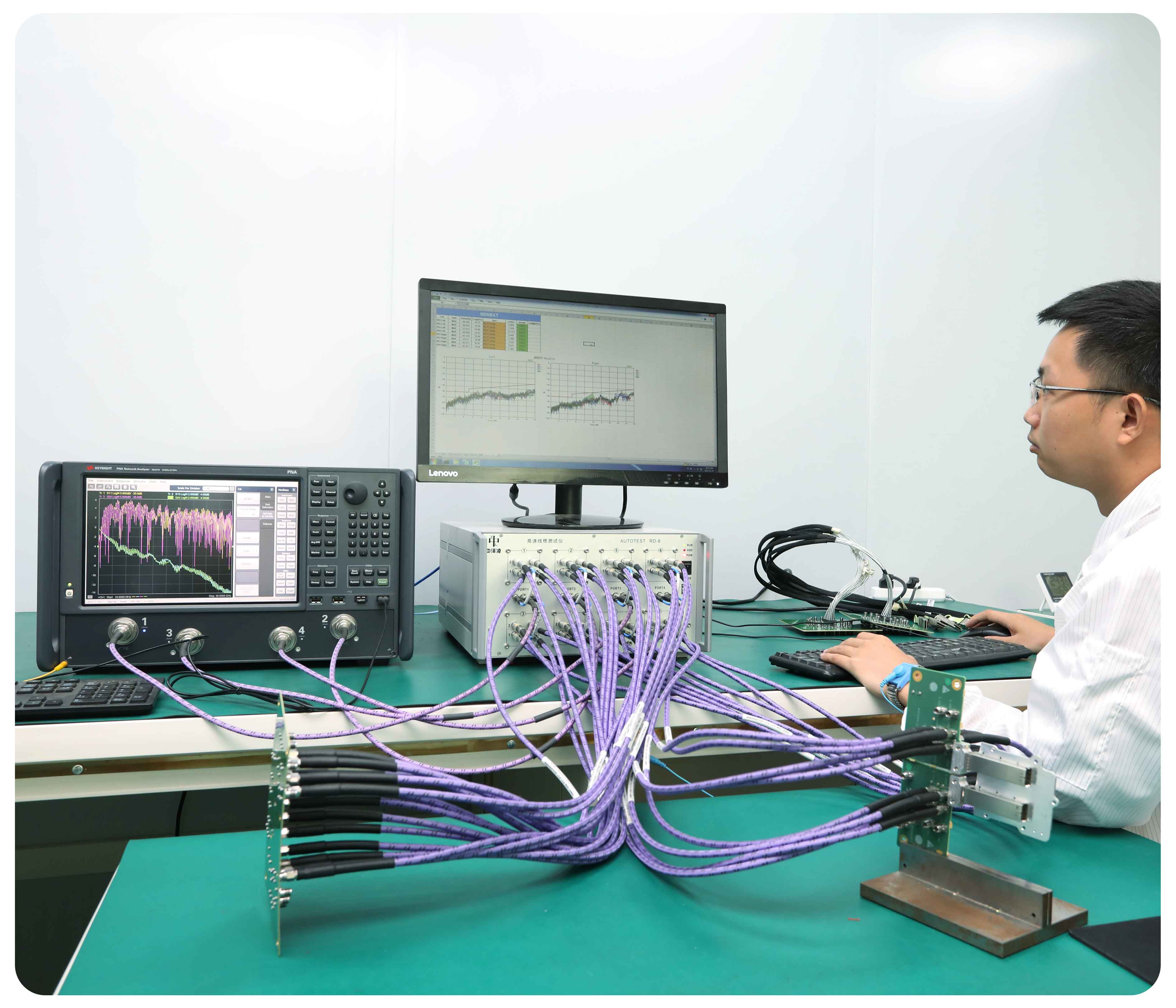
Reliability testing is performed in-house as part of BEXKOM connector development, from tooling through assembly.
Materials and contact finish, in plain terms
Gold-plated brass contacts and PPS or PEEK insulation are chosen because a monitoring channel carries very small currents: contact resistance and its stability dominate the electrical behaviour. A plated contact interface resists the surface oxidation that would otherwise raise and destabilise resistance over time, while a dimensionally stable insulator keeps contact alignment repeatable after repeated mating. Shell material is a separate decision — PC/PSU housings in the P Series support non-metallic patient-side interfaces, while chrome-plated brass shells in the BK-B-XXX platform serve equipment-side connections that need mechanical strength.
Step-by-step: specifying a push-pull connector for an ECG monitoring project
Six steps cover the decisions that most often cause rework when they are deferred to the end of a design cycle.
- Count the channels, not just the electrodes. Map the required conductors — leads plus shield and ground — to the available range. BK-P-XXX covers 2–26 pins and BK-B-XXX covers 2–48 pins, so both single-module and multi-channel harnesses can stay within one family.
- Separate patient-side from equipment-side connections. Decide which interface uses the PC/PSU-shelled P Series connector and which uses the brass-shelled BK-B-XXX platform, then confirm the two cannot be interchanged during use.
- Fix the insulation requirement with your compliance engineer. Working from the IEC 60601-1 framework and its MOPP/MOOP insulation expectations lets you match the required dielectric behaviour to the 450–2100 V test voltage range recorded for both families.
- Choose the sealing level. IP50 is the rating for the standard BK-P-XXX configuration; IP65 is available for interfaces exposed to wipe-down or splash. Over-specifying the seal adds cost without clinical benefit.
- Confirm locking and mechanical duty. Push-pull locking is standard across both families. Where the harness is repeatedly connected, the >5000-cycle rating of BK-B-XXX provides more mechanical margin than the >2000-cycle P Series rating.
- Collect the document set and validate a sample. Assemble the certificate package before the design review, then order a sample: the minimum order quantity is 1 unit, typical production lead time is 3–15 days, every unit passes 100% testing, acceptance combines a pre-shipment test with a 15-day inspection period, and the products carry a 12-month quality guarantee.
Where the monitoring cable itself is part of the project scope, BEXKOM provides OEM and ODM production including logo printing, cable assembly, wire harness and new design, supported by 22 R&D engineers and more than 30 new custom projects taken on each year. A dedicated sample design team and pilot production line typically deliver prototypes within two weeks, which is usually fast enough to sit inside an ECG program's verification phase rather than after it.
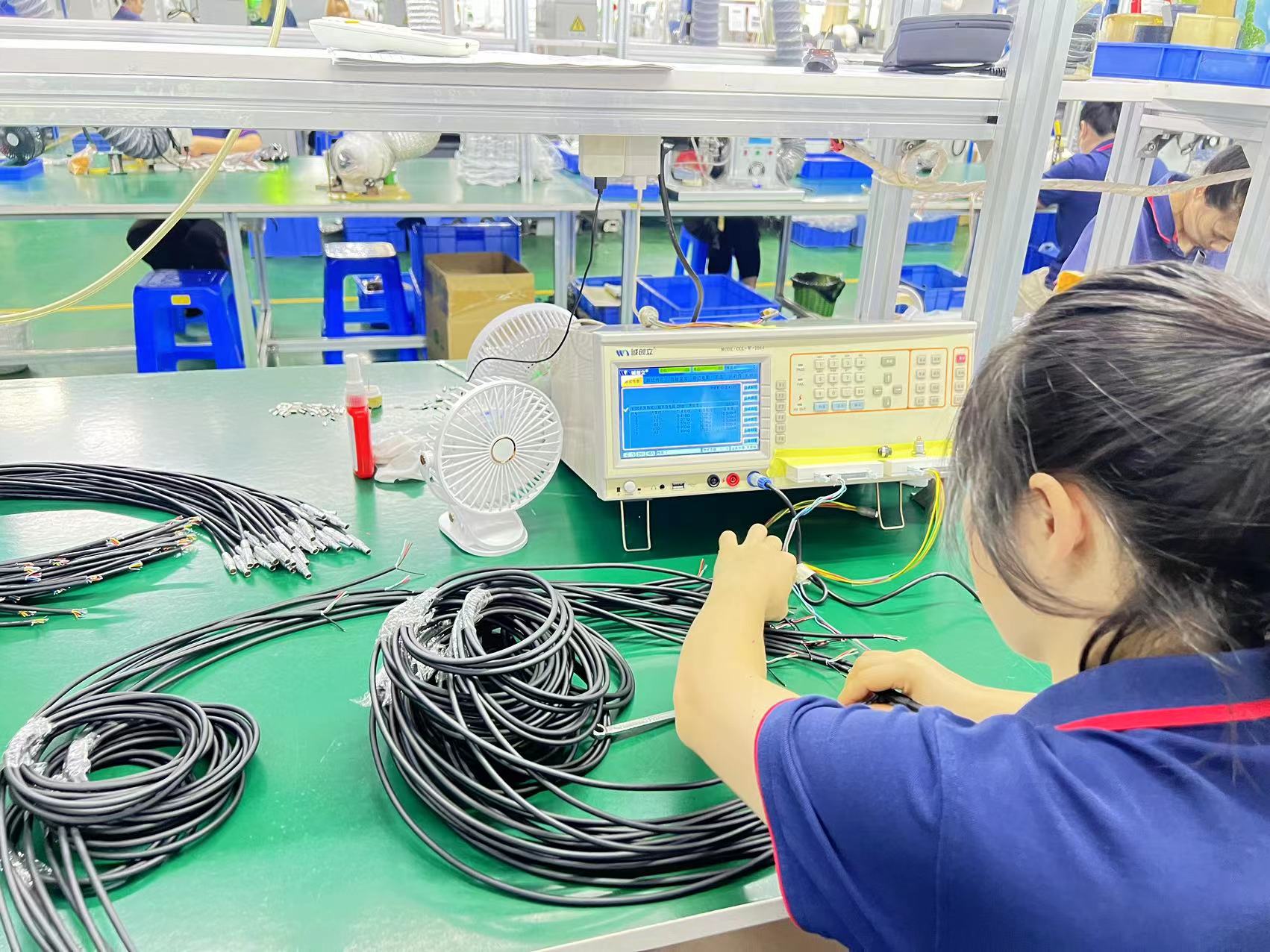
Outgoing quality control: every unit is tested before shipment rather than sampled by batch.
Use cases: two deployments that show how these requirements are met
A U.S. patient monitoring program is the closest available reference for an ECG monitoring application. BEXKOM supplied 10,000 units to a Medical ODM customer for patient monitor applications within a five-year partnership; the program reached a qualified result, and the customer's stated highlights were fast delivery and low cost. For an ECG buyer, the relevant points are continuity of supply across a multi-year program and a documented qualification outcome rather than a single delivered batch.
A second, non-medical deployment illustrates the mechanical durability of the same push-pull platform. An automotive customer in Germany used product 3625 for testing purposes, with 20,000 units installed and the project completed within five years; the recorded highlights were quick mating and de-mating and stable operation with reliable connecting. Repeated connection and disconnection is exactly the duty cycle a monitoring cable sees at the bedside, so the mating behaviour described here transfers directly to clinical use.
Comparison: which BEXKOM push-pull family fits which ECG interface
The table below compares the three push-pull options most often considered for monitoring equipment. All figures are BEXKOM published specifications.
| Parameter | BK-P-XXX — Medical (P Series) | BK-B-XXX — Push Pull (product 3625) | BK-M12-XXX — M12 |
|---|---|---|---|
| Pin numbers | 2–26 | 2–48 | 3–19 |
| Current rate | 1.5–13 A | 1.5–25 A | 1.0–16 A |
| Testing voltage | 450–2100 V | 450–2100 V | 250–1900 V |
| Waterproof level | IP50 / IP65 | IP50 | IP67 |
| Work temperature | −55 to 125 °C | −55 to 250 °C | −25 to 80 °C |
| Salt spray resistance | 96 hours | 96 hours | 48 hours |
| Mating cycles | >2000 times | >5000 times | >500 times |
| Locking method | Push-pull locking | Push-pull locking | Screw locking |
| Insulator material | PPS / PEEK | PPS / PEEK | PA66 |
| Shell material | PC / PSU | Brass, chrome plated | Brass, chrome plated |
| Implemented industry | Medical | Medical, industrial, MIL, equipment, automation | Automation, robot, industrial, power, testing |
The pattern is straightforward. The P Series is the patient-side choice because of its non-metallic shell option and medical positioning. The BK-B-XXX platform is the choice for equipment-side and higher-cycle interfaces. The M12 family, with screw locking and IP67 sealing, addresses industrial automation rather than monitoring cables — its higher ingress protection is useful, but screw locking is slower at the bedside than push-pull release.
Frequently asked questions
What certifications and standards apply to a push-pull connector used in ECG monitoring?
Medical electrical equipment is commonly specified against IEC 60601-1, which covers basic safety and essential performance, including insulation requirements such as MOPP and MOOP (IEC / Digikey whitepaper). BEXKOM's medical push-pull range is backed by an ISO13485 certificate (ZK202504252281, ZK International, valid 14 Feb 2025 to 13 Feb 2028), an ISO9001 certificate (ZK2025060258206, valid 16 Jan 2026 to 15 Jan 2029), a USA-market UL test report (Baide-BEXKOM-UL-001, Baide, valid 13 Jun 2024 to 12 Jun 2027), an EU Certificate of Conformity (MTL24052400318R01) covering RoHS 2.0 Directive 2011/65/EU Annex II (EU) 2015/863 with testing to IEC 62321-3-1:2013, IEC 62321-7-1:2015, IEC 62321-4:2013+A1:2017, IEC 62321-7-2:2017, IEC 62321-5:2013, IEC 62321-6:2015 and IEC 62321-8:2017 (valid 4 Jan 2024 to 3 Jan 2027), and a REACH report (OBCR240524010, valid 24 May 2024 to 23 May 2027).
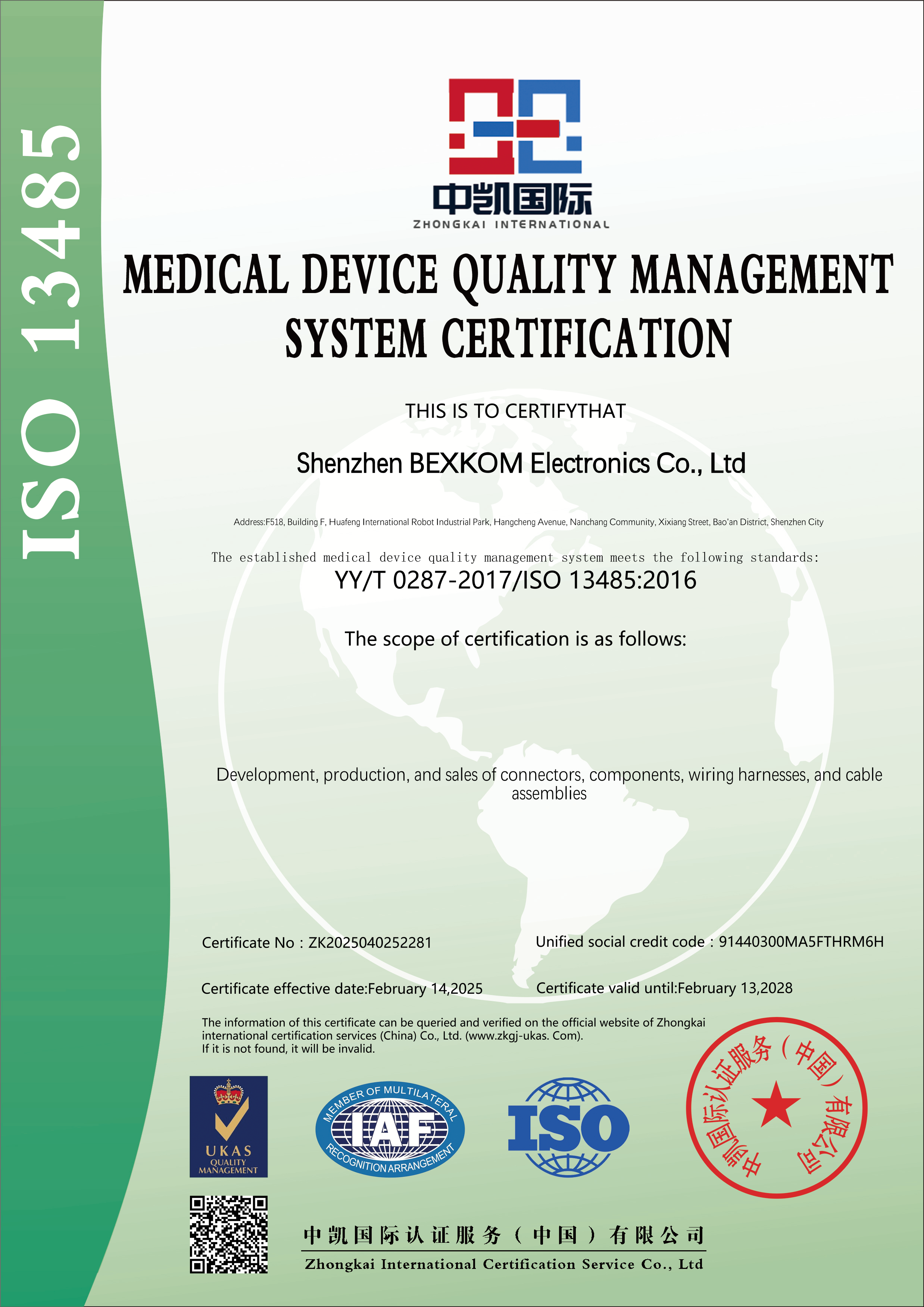
ISO13485 certificate ZK202504252281, issued by ZK International and valid until February 2028.
Can a push-pull connector be customized for a specific ECG monitor design?
Yes. BEXKOM's BK-P-XXX medical connector series covers 2 to 26 pins, 1.5 to 13 A, 450 to 2100 V test voltage, IP50 or IP65 sealing, PPS or PEEK insulation, PC/PSU shell material and push-pull locking, while the BK-B-XXX platform (product 3625) covers 2 to 48 pins, 1.5 to 25 A and optional EMC shielding. BEXKOM operates OEM and ODM production with customization for logo, cable assembly, wire harness and new design, supported by 22 R&D engineers and more than 30 new custom projects per year; prototypes are typically delivered within two weeks.
What drives the cost of a medical push-pull connector for ECG monitoring?
Cost is driven by configuration rather than by category: pin count, shell material, PPS versus PEEK insulator, IP50 versus IP65 sealing, whether EMC shielding is required, cable assembly content and order volume. BEXKOM quotes per project; commercial terms are a 1-unit minimum order quantity, delivery terms FOB/C&F/CIF/DAP/DDP/EXW, and payment by T/T, Paypal or credit card. In a U.S. Medical ODM patient monitoring program covering 10,000 units, the customer's stated highlights were fast delivery and low cost.
How is a sample validated before production?
Evaluation can start with a single unit, because the minimum order quantity is 1. Every unit passes 100% testing before shipment, and acceptance combines a pre-shipment test with a 15-day inspection period, under a 12-month quality guarantee. The U.S. patient monitoring program reached a qualified result through this validation path.
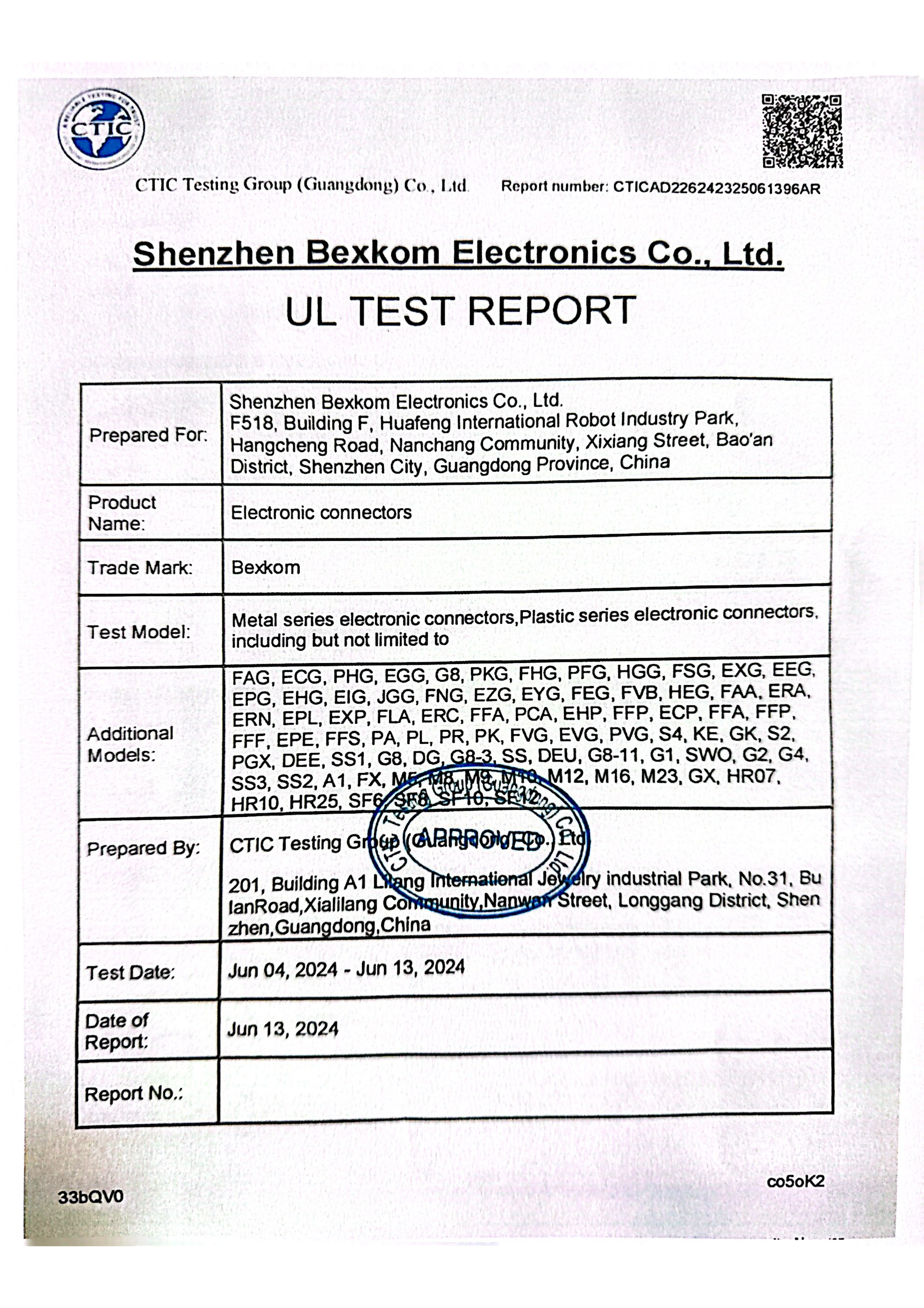
UL test report Baide-BEXKOM-UL-001, issued by Baide for the USA market and valid until June 2027.
What lead time and capacity should an ECG monitoring program plan for?
Typical production lead time is 3 to 15 days, monthly capacity is 200,000 units, and annual output is 2,000,000 units. About 75% of BEXKOM sales are exported, primarily to EU and USA markets.
How do we start a push-pull connector evaluation for an ECG monitoring project?
Send the channel count and pin requirement, sealing level, insulation requirement and cable assembly scope, and BEXKOM will return a sample and quotation. The team can be reached at cs6@bexkom.com or WhatsApp +86 18681568601, and the product catalogue is available for download.
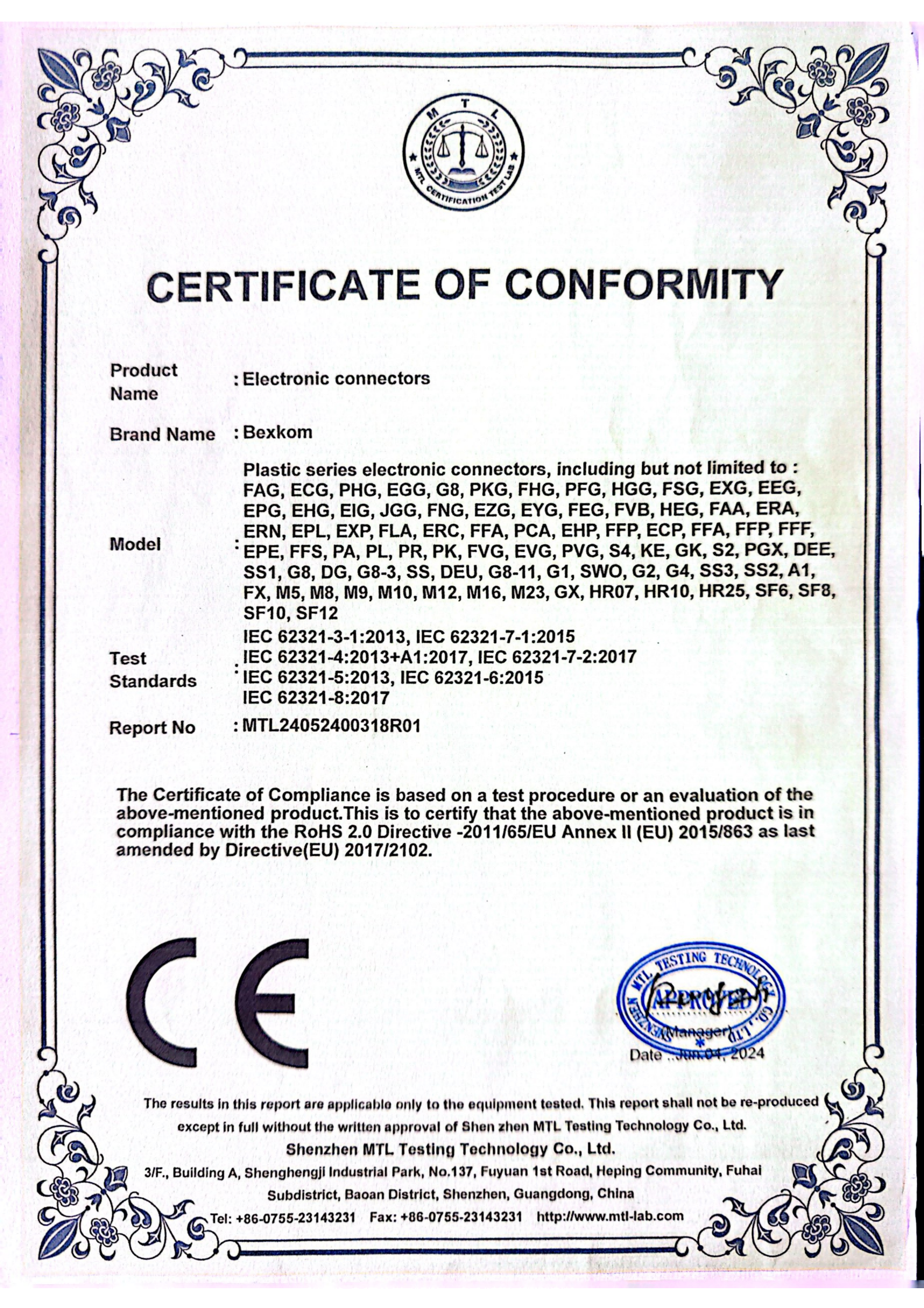
EU Certificate of Conformity MTL24052400318R01, covering IEC 62321 test methods and RoHS 2.0 Directive 2011/65/EU Annex II (EU) 2015/863.
Conclusion and next step
Specifying a push-pull connector for ECG monitoring comes down to four decisions: the pin count that carries every lead, shield and ground conductor; the locking type that keeps the interface secure while staying fast to release at the bedside; the sealing and material choices that match the clinical environment; and the certificate package that closes the compliance file. The electrical headroom offered by both BEXKOM families — 1.5–13 A for the BK-P-XXX P Series and 1.5–25 A for the BK-B-XXX platform, with a 450–2100 V test voltage range — is not the constraint in a low-power monitoring channel, but the stability evidence behind it is what buyers should verify.
Two reference points support that verification: a U.S. patient monitoring program that reached a qualified result with 10,000 units over five years, and an ISO13485-certified quality system with USA and EU conformity documents that an auditor can review. The remaining variable is configuration, and that is quoted per project.
Request a sample or quotation
Send your ECG monitoring requirements — pin count, sealing level, insulation requirement and cable assembly scope — to cs6@bexkom.com or WhatsApp +86 18681568601. Sample orders start at 1 unit, with typical production lead time of 3 to 15 days.
Download the BEXKOM connector catalogue (PDF) · www.bexkom.com
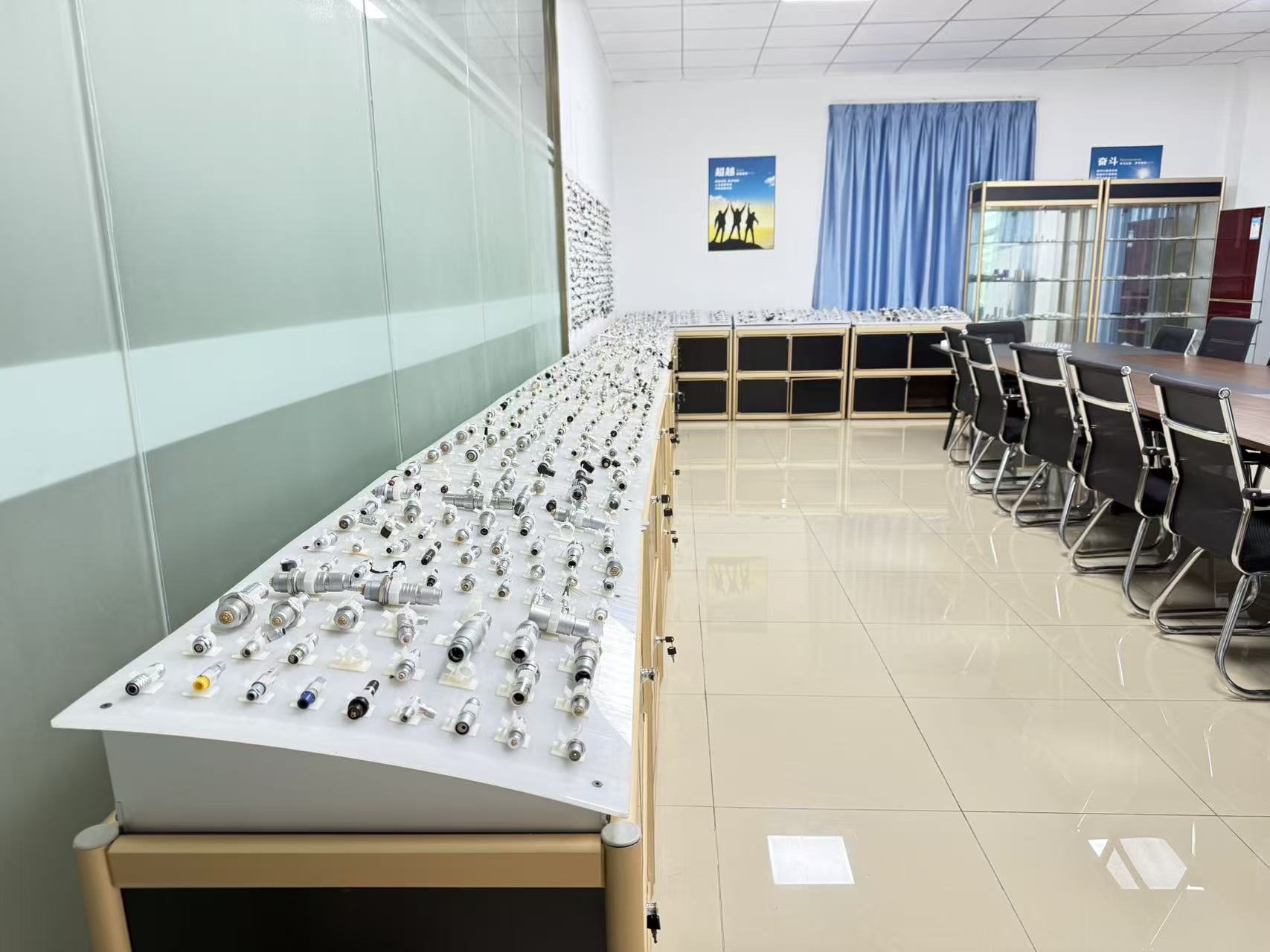
Sample evaluation units — a 1-unit minimum order quantity is available for design verification.
Have Questions or Need More Details?
Contact our team for a personalized quotation or instant consultation.
Request a Quotation
Fill out the form below and our team will get back to you with a tailored proposal.
WhatsApp Direct Chat
Prefer to chat in real-time? Message us on WhatsApp for instant assistance & quick answers.
- Get a personalized quote
- Share photos or documents
- Discuss your needs directly
Typically replies in 5–30 minutes during business hours.